




Bolt Team · Updated November 25, 2026
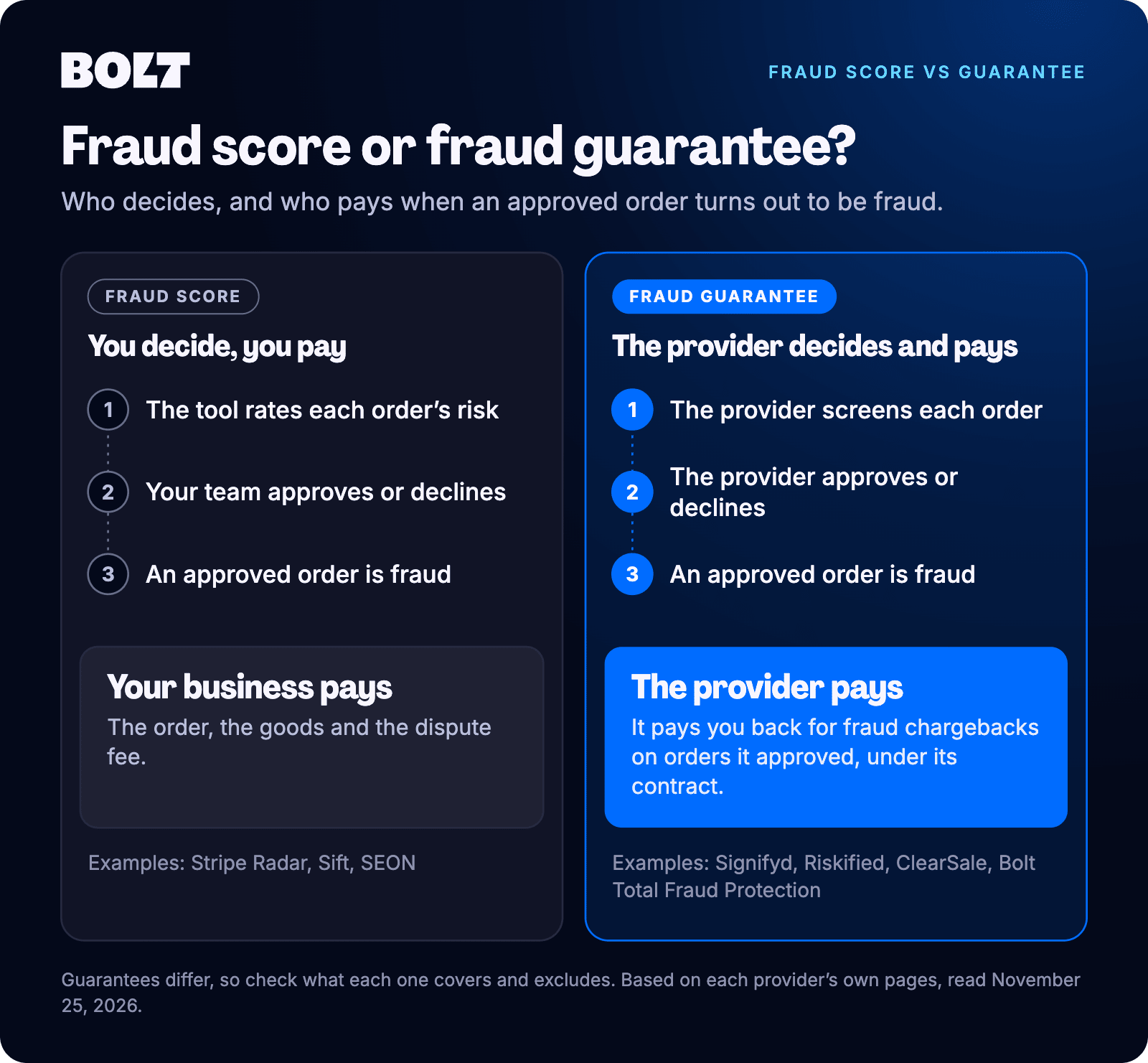
Short answer: A fraud score rates how risky each order looks and leaves the decision, and the cost of any fraud chargeback, with your team; a fraud guarantee makes the decision for you and pays back fraud chargebacks on the orders it approves. Choose a score if you want control of the rules and can absorb some fraud loss; choose a guarantee if fraud chargebacks or manual reviews are a large or unpredictable cost.
Bolt publishes this guide, and Total Fraud Protection is our product. Every fact about another company comes from that company's own site, read on November 24, 2026.
Guarantee, score and dispute recovery side by side
| Fraud score | Fraud guarantee | Dispute recovery and alerts | |
|---|---|---|---|
| What you get | A risk score or level for each payment, plus rules | An approve-or-decline decision, backed by reimbursement | Help fighting or heading off chargebacks after they're filed |
| Who decides | Your team | The provider | Not applicable: works after the sale |
| Who pays for a fraud chargeback on an approved order | Your business | The provider, under its contract | Your business, unless the dispute is won or refunded early |
| Typical pricing | Monthly plan or per screened transaction | Share of approved orders, or a per-transaction rate | Share of recovered amounts, or a fee per alert |
| Examples (from their own pages) | Stripe Radar, Sift, SEON | Signifyd, Riskified, ClearSale, Bolt Total Fraud Protection | Chargeflow, Stripe Smart Disputes |
Sources: see the Sources section; all read November 24, 2026.
How a fraud score works
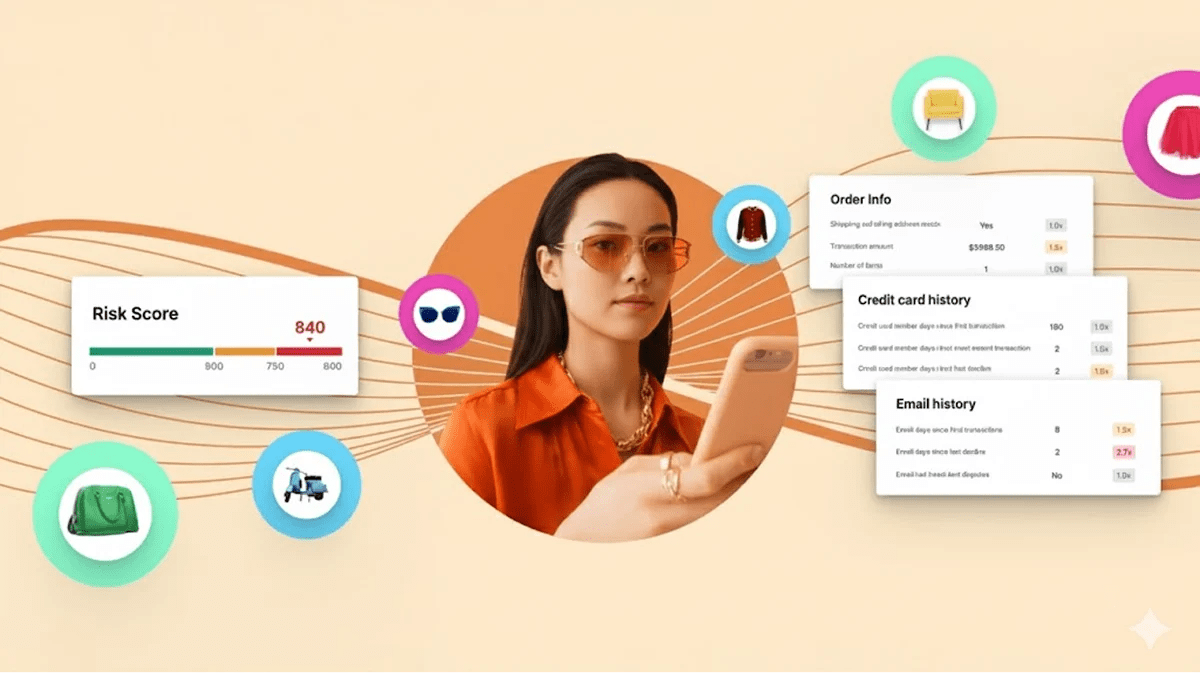
A scoring tool looks at each payment (device, identity, history, behavior) and returns a number or a level. Your team decides what to do with it: approve, decline, send to manual review, or ask for extra authentication. Stripe Radar, for example, lets teams on its Plus tier "write and backtest custom rules, set risk tolerance" [R4]; Sift evaluates each transaction "in under 150 milliseconds" [SF1].
The trade-off: you get control, and you keep the loss. When an approved payment turns into a fraud chargeback, your business loses the goods, has the payment taken back and pays the dispute fee. On Stripe that fee is $15 per dispute received [R3].
Scoring suits teams that have fraud analysts, want to tune rules themselves and can absorb some fraud loss. See Stripe Radar alternatives and Sift alternatives.
How a fraud guarantee works
A guarantee provider runs its own screening, makes the approve-or-decline call, and pays you back if an order it approved turns into a fraud chargeback. Signifyd puts it as "If we're wrong, we cover it" [SG4]; Riskified's model is "Pay only for approved orders that generate revenue" [RK1].
A provider that pays for approved fraud, and is paid only on approved orders, has a reason both to stop fraud and to approve good orders. Not every contract is priced that way, so ask how the provider reports good orders it declined. You give up control of the rules in exchange for a predictable fraud cost and fewer manual reviews.
Guarantees differ, so read the terms:
- Scope. Most cover fraud chargebacks only. Signifyd offers a guarantee that can extend to "a total chargeback liability shift" [SG1]; Shopify Protect covers "fraudulent and unrecognized chargebacks" on eligible Shop Pay orders only [SP1].
- Exclusions. Look for manually approved orders, address changes after checkout, product types and order-size caps. NoFraud, for example, publishes per-transaction coverage caps of $500 to $2,000 by tier [NF1].
- Price. A share of approved order value, a published rate, or a monthly minimum.
See Signifyd alternatives and Riskified alternatives for the guarantee providers side by side.
Where dispute recovery and alerts fit
Dispute recovery helps after a chargeback is filed: gathering evidence and sending the response. Chargeflow, for example, charges 25% per recovered chargeback and $29 per alert [CF1]; Stripe's Smart Disputes charges 30% of the amount on won disputes [R3]. Recovery tools work alongside a score or a guarantee. They're most useful for non-fraud disputes, which fraud guarantees usually don't cover. See best chargeback protection services.
Which do you need? A decision guide
| If this is true | Lean toward |
|---|---|
| You have fraud analysts and want to own the rules | A score |
| Fraud chargebacks are small and steady | A score |
| Fraud chargebacks are a large or unpredictable cost | A guarantee |
| Your team spends hours a day on manual review | A guarantee |
| You decline good orders to keep chargebacks down | A guarantee |
| Most of your disputes are "item not received" or "not as described" | Dispute recovery, or a guarantee that covers non-fraud disputes |
| You sell in a high-risk industry and chargebacks threaten your account | A guarantee plus close monitoring of your chargeback rate |
Many merchants use two: a guarantee for fraud and a recovery tool or in-house process for everything else.
What fraud really costs: the math
The cost of a fraud chargeback on a scoring tool isn't just the order. Add up:
- the order value (refunded to the cardholder);
- the goods and shipping you can't recover;
- the dispute fee your processor charges;
- the time your team spends on review and disputes;
- the good orders your rules declined.
Compare that total with what a guarantee costs on the same volume. The chargeback cost calculator runs these numbers for your business.
Where Bolt fits
Bolt offers both models. Total Fraud Protection is the guarantee, inside Bolt checkout or as a standalone add-on:
- Guarantee: with Total Fraud Protection, Bolt covers 100% of fraud chargebacks on approved orders, for qualifying transactions under your Bolt agreement.
- Price: 0.79% per transaction (may vary by industry).
- Score: Bolt also offers Assisted Fraud Protection, a fraud-scoring plan, at $0.30 per transaction. The chargeback guarantee comes with Total Fraud Protection.
- Signals: Bolt scores every order against 200+ data signals, using signals from its overall network of 140 million shoppers.
- Processor choice: Bolt Payments or an approved third-party processor with application programming interface (API) hook-ins; also a standalone add-on without Bolt checkout. See fraud protection across payment processors.
- Non-fraud disputes: not covered. Bolt helps, including a tool that compiles the evidence; the merchant fights the dispute and is liable if it's lost.
- Chargeback fee: on Bolt Payments (US only), $7.50 per chargeback, half the industry standard of $15.
See Bolt fraud detection and chargeback protection or try the chargeback cost calculator.
Sources
All competitor pages read November 24, 2026.
- [R3] https://stripe.com/pricing (dispute fees, Smart Disputes)
- [R4] https://docs.stripe.com/radar/how-radar-works
- [SF1] https://sift.com/platform/payment-protection/
- [SG1] https://www.signifyd.com/pricing/
- [SG4] https://www.signifyd.com/
- [RK1] https://www.riskified.com/chargeback-guarantee/
- [NF1] https://www.nofraud.com/pricing
- [SP1] https://help.shopify.com/en/manual/payments/shopify-protect
- [CF1] https://www.chargeflow.io/pricing
- SEON (scoring example): https://seon.io/pricing/
- ClearSale (guarantee example): https://clear.sale/pricing
Bolt sources: https://www.boltapp.com/fraud, https://www.boltapp.com/pricing.
Stripe, Sift, Signifyd, Riskified, NoFraud, Shopify, Chargeflow, SEON and ClearSale are trademarks of their respective owners. Bolt is not affiliated with or endorsed by any of them.
FAQ
What's the difference between a fraud score and a chargeback guarantee?
A score tells you how risky an order looks, and you decide. A guarantee provider decides for you and pays you back if an approved order turns into a fraud chargeback.
Is a chargeback guarantee worth it?
It depends on what fraud costs you now. If fraud chargebacks, dispute fees and manual review add up to more than the guarantee's price on the same volume, it usually is. The chargeback cost calculator helps you compare.
Do chargeback guarantees cover all chargebacks?
Usually not. Most cover fraud chargebacks on approved orders only; some providers offer wider cover. With Total Fraud Protection, Bolt covers 100% of fraud chargebacks on approved orders, for qualifying transactions under your Bolt agreement; non-fraud disputes stay with the merchant.
Riskified vs Signifyd vs Sift: which is best for ecommerce fraud prevention?
Riskified and Signifyd are guarantee providers; Sift is a scoring platform. Choose a guarantee to move the fraud loss off your books; choose scoring to keep full control of the rules.
Can I use a fraud score and a guarantee together?
Yes, though you may pay to screen the same order twice. A more common pairing is a guarantee for fraud and a dispute recovery tool for non-fraud disputes.
What is the best fraud detection software for online payments?
There's no single best tool; pick by who should carry the fraud loss. See best fraud detection software for online payments (2026) for a side-by-side comparison.