
Alternative Payment Methods (APM): Beyond Just Credit Cards
Sep 19, 2022



We live in a time where convenience is top of mind and we can observe this trend in many industries. In the food delivery space, you can easily obtain a meal from almost any restaurant in town without having to leave your home or even make a phone call. DoorDash, UberEats and others have helped transform the restaurant landscape by catering to the consumer demand for simplicity and convenience.
Consumers also demand convenient and seamless options in the payments world. This has helped pave the way for many new alternative payment methods (APMs) that extend beyond cash and credit cards.
Some of the most popular APM’s in the US are:
- Digital Wallets: services like Apple Pay, Google Pay, PayPal, Venmo
- Buy Now, Pay Later (BNPL): services like Affirm, Klarna and Afterpay
- Cryptocurrency: Bitcoin, Ethereum and others.
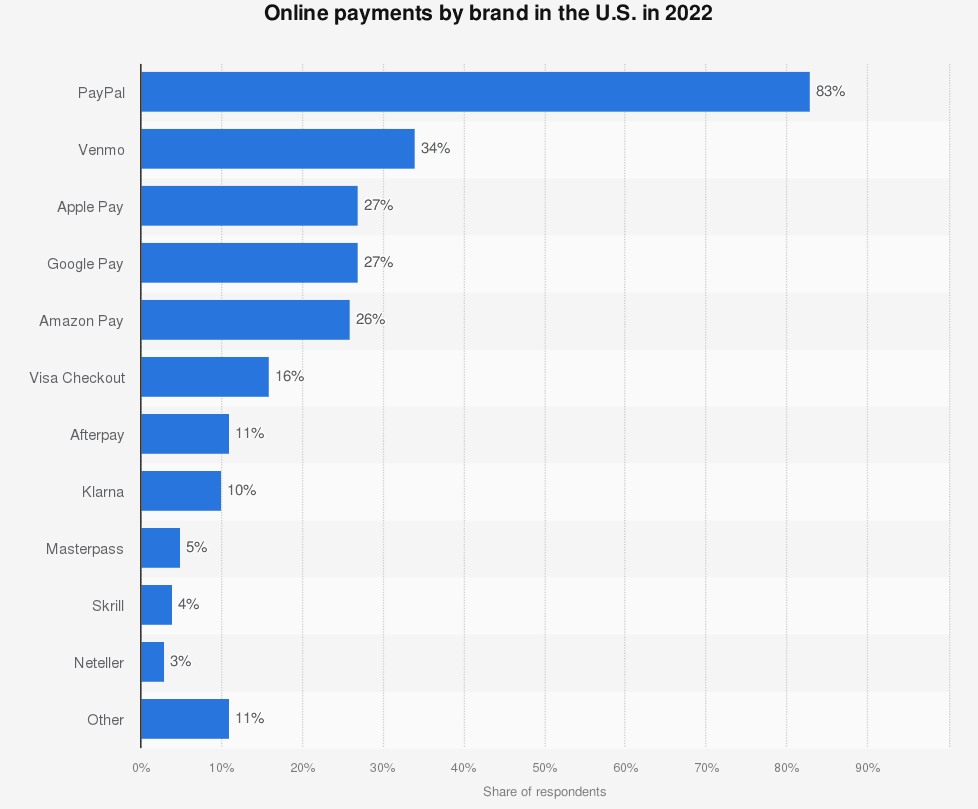
Statista’s “Online payments by brand in the US in 2022” survey showed that a significant portion of respondents who used online payment methods, use PayPal (83%) and many other APM’s such as Venmo (34%) and Apple Pay (27%).

In 2022, within Bolt’s network, we see that 80%-90% of our largest merchants offered some form of APM option via Bolt’s checkout. The chart below shows what % of Bolt merchants offered APM’s, based on top GMV percentiles.
We can clearly see a trend of increased adoption as we move towards our biggest retailers.


However, it’s worth noting that APM usage varies by retail category. Within the Bolt network, Apparel & Accessories is seeing the most usage with about one-third of sales volume coming from APM’s.
APM’s % of eCommerce Sales Volume:
- Apparel & Accessories: 33%
- Beauty & Skincare: 23%
- Sporting Goods & Fitness: 16%
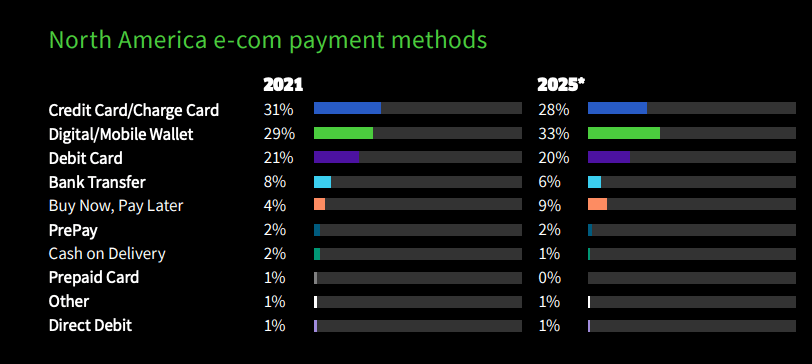
Although APM adoption varies by industry, there is a positive trend across the board which helps increase overall usage. WorldPay’s “The Global Payments Report” outlines the share of payment methods below. Within a few years, digital wallet usage is expected to exceed credit card usage and the BNPL segment will more than double in share.

If, as a merchant, you are on the fence about whether offering APM’s would benefit your business, bear in mind that if shoppers cannot check out with their preferred payment method, they may very well choose to shop elsewhere. According to a consumer survey conducted by SaleCycle, 6% of shoppers had abandoned carts due to a lack of payment options! This survey, in unison with what we are seeing in our own data, directionally points towards APM’s being a valuable form of payment for consumers.
Klarna also estimates that retailers who offer BNPL options see an AOV (average order value) increase of 45%. We looked into some of the higher ticket categories in our network, such as Auto Parts and Electronics, and saw lifts of 133% and 122% respectively over corresponding credit card orders. Triple digit lifts in AOV are not to be expected for all categories, however, double digit growth seems realistic.

Overall, it makes sense to increase the number of payment options available to your customers as APM’s are surging in popularity over the next few years. Combine that with the knowledge that customers will choose to shop elsewhere if they can't use their preferred payment method, it makes sense to start investing in APM’s now.
Note that not every APM will be the perfect fit for every merchant, and you do not want to go overboard with an overwhelming array of options for shoppers at checkout. That is why we recommend understanding what APM’s cater best to your shopper demographics.
This will help provide a seamless checkout experience that will increase conversions, grow your customer base, and develop customer loyalty. The optimal checkout experience would dynamically surface payment information based on a customer’s profile for a streamlined experience.