


The presents have all been opened, the last crumbs of cookie have been eaten, and that “best-of” countdown is just about wrapped. Yep, another holiday shopping sprint is in the books!
But forward-looking merchants know it’s already time to study the lessons learned and map out the coming year’s game plan. The insights within this report promise to take your dedication, innovation, and holiday hustle into overdrive.
We've collected and analyzed Bolt data to better understand what worked in 2023 and what's poised to happen in 2024. In December 2023, we also surveyed 100+ decision makers at US-based enterprise ecommerce brands that sell physical goods and that have online sales revenue of >$100M.
Taken together, these insights offer a unique window into 2024’s retail landscape. Our goal, as ever, is to provide the information you need to make informed choices in the year ahead. Let's jump in.
Unwrapping 2023’s record-breaking season
Cyber Monday shattered the single-day sales record by crossing $11 billion spent online, while Black Friday and Thanksgiving also gained ground for a truly historic opening weekend. In total, the eight highest volume days over the holidays were:
- Cyber Monday (Nov 27)
- Black Friday (Nov 24)
- Sunday of Cyber Five (Nov 26)
- Saturday of Cyber Five (Nov 25)
- Monday (Dec 11)
- Thanksgiving (Nov 23)
- Monday (Dec 4)
- Monday (Dec 18)
Mondays constituted half of the top eight shopping days, and Cyber Monday came out on top during the mad year-end dash. Consumers consistently picked up momentum heading into the workweek, with the first business day of the week outperforming any other day both by total transaction volume and aggregate consumer spending.

Outside the Cyber Five stretch (the five days spanning Thanksgiving to Cyber Monday), Thursdays through Sundays marked peak periods for pricier purchases. That four-day sequence saw shoppers grabbing higher ticket items and boasted a 9% lift in average order value (AOV) over other holiday windows.
Payment trends reflect evolving preferences
The final numbers also revealed shifting payment preferences as economic uncertainty nudged budget-conscious shoppers toward flexible financing options. Most notably:
- Apple Pay emerged as the breakout payment star, increasing 72% in adoption year-over-year — the largest jump of any alternative payment method.
- Afterpay declined the most in usage, dropping 21% as consumers gravitated toward different installment plans.
- Food & Beverage led in adoption of alternative payment methods (APM) with a 36% annual increase. Automotive was strangely the only vertical that saw APM usage decrease by 3% annually.
- Mirroring APM shifts, Automotive was the sole category that saw an increase in credit card usage by 1% YoY while all other segments saw a decline.
Mobile purchases also continue taking share across categories, with furniture and home goods seeing the largest annual jump by 7% in smartphone checkouts.
Uncovering 2024's biggest ecommerce priorities
Through a survey of over 100 enterprise merchants, our team uncovered some clear retail rallying cries for 2024. Let’s examine what retailers shared about what’s on the horizon for their ecommerce businesses.
Which trends will most impact your ecommerce business in 2024?
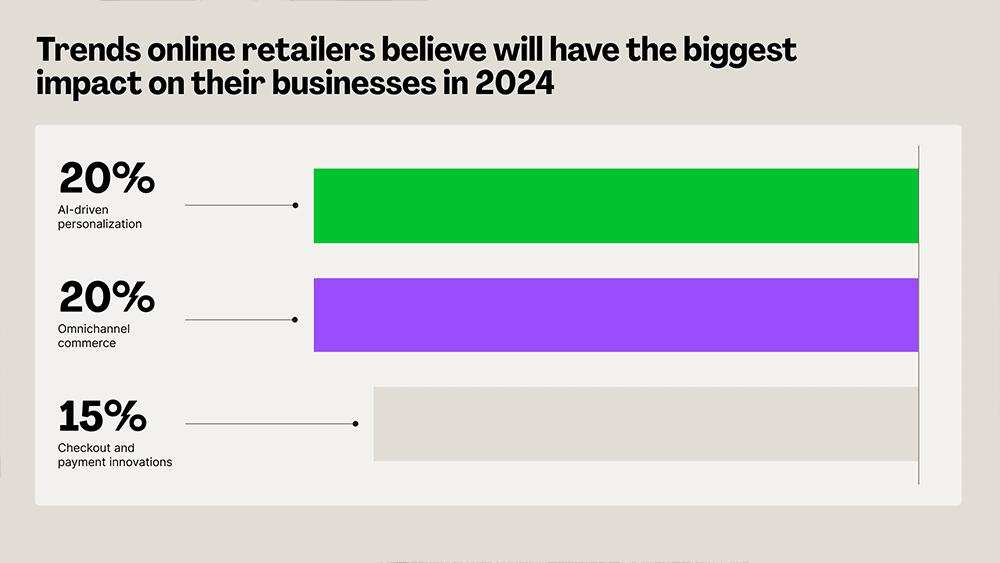
Our poll reveals personalization and cross-channel shopping taking center stage in 2024. Over 20% believe AI-powered customization and generative content will have the greatest impact, while another 20% highlight increased omnichannel focus as pivotal to their businesses. Checkout and payment innovations like passwordless/biometric login also ranked highly at nearly 15%, as merchants emphasize look to conveniences that earn loyalty.
What are the biggest ecommerce challenges in 2024?
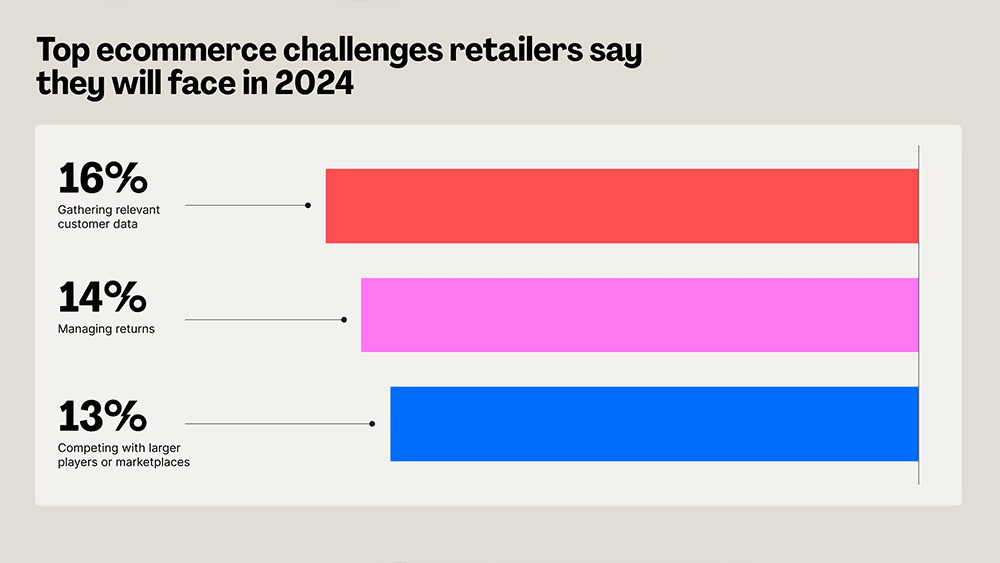
When asked about their largest ecommerce hurdles this year, retailers emphasized consumer data collection, returns, and competition. 16% called out acquiring customer data and insights as imperative—used to optimize internal operations, supply chain management, delivering more personalized experiences, and more. Managing escalating returns and associated costs concerned almost 14%, while over 13% pointed to competing against retail goliaths as a particular 2024 pressure point.
How will you address rising return costs and rates?

With returns top of mind, 42% of retailers plan on leveraging AI and augmented reality to enable consumers to visualize and try on products—all in an effort to curb return volume. 25% cited offering enhanced product education like reviews and sizing guides to get the right fit the first time.
What is your main 2024 ecommerce focus?
When ranking 2024 ecommerce focus areas, optimizing operational components for greater efficiency came up on top, with 31% of retailers saying that was their main priority. Meanwhile 28% emphasized retaining and enhancing loyalty through repeat customer satisfaction. Acquiring new consumers ranked third at 21%.
For retailers, 2024 promises to reward those delivering innovation centered on individual consumers through any access point. Friction-free shopping, personalization, and convenience hold the keys to hearts, minds, and wallets.
Decoding what's next: 2024's big retail predictions
From first-party data to frictionless returns, the next evolution of commerce hinges on identity intelligence and optimized shopper experiences. Using Bolt’s data and experience, as well as what we learned from our retail partners, we’ve laid out five predictions that will define 2024:
Prediction 1: Collecting more first-party data takes center stage
Given that Google is finally eliminating cookies this year, knowing one’s shopper on an individual basis becomes paramount. Retailers also realize that generic segmentation no longer suffices. Merchants will scramble to get shoppers to create accounts and/or enrich incomplete user profiles, because consumer recognition is critical in order to offer a friction-free, personalized shopping experience. That sits at the core of leveling up loyalty and lifetime value.
Prediction 2: Personalization at scale through AI
Generating tailored experiences depends on accurately identifying visitors—you can’t personalize without knowing the person. Once retailers have robust consumer profiles, AI can help elevate customer engagement to new heights. Algorithms can surface discoveries perfectly matching visitor histories while transactions train ever-improving recommendations.
Prediction 3: Reducing returns with AI
AI will also help generate more predictive tools to reduce returns before they happen. For example, AI-driven network insights can be used to personalize return offers to incentivize shoppers to keep their orders. Reducing revenue loss from return rates boosts margins and loyalty simultaneously — a win-win for both retailers and shoppers.
Prediction 4: Distributed commerce takes flight
Retailers will leverage channels outside their ecommerce sites even more to increase sales. In the year ahead, discovery and transactions will converge as users increasingly browse and check out directly from search, social media, email, live shopping, and more. For retailers, letting their customers buy instantly from wherever they’re browsing with no redirects means higher conversion. In fact, Bolt merchants see as much a 6X more conversion with Checkout Everywhere vs. standard affiliate redirects. 2024 will be the year of retailers meeting their customers at the point of inspiration.
Prediction 5: Physical Retail Strikes Back
For years, legacy retailers have scrambled to catch up digitally while their brick-and-mortar presence languished. The tide has turned: those storefronts have become a competitive advantage. Omnichannel emerges supreme, blending physical and digital into sticky localized ecosystems. Now, physical retailers that have superb digital experiences have a leg up over their digitally native peers because they can build loyalty around in-store convenience.
The future remains uncertain, but retailers wield more predictive power than ever thanks to amplifying technology. With the right foundations rooted in customer data and innovation, merchants can flourish regardless of economic headwinds. We can’t foresee precisely how 2024 unfolds, but the tools to offer seamless, personalized experiences at any touchpoint of the customer journey already exist—and we are still in the early days of ecommerce all things considered.